
How to choose a grind setting
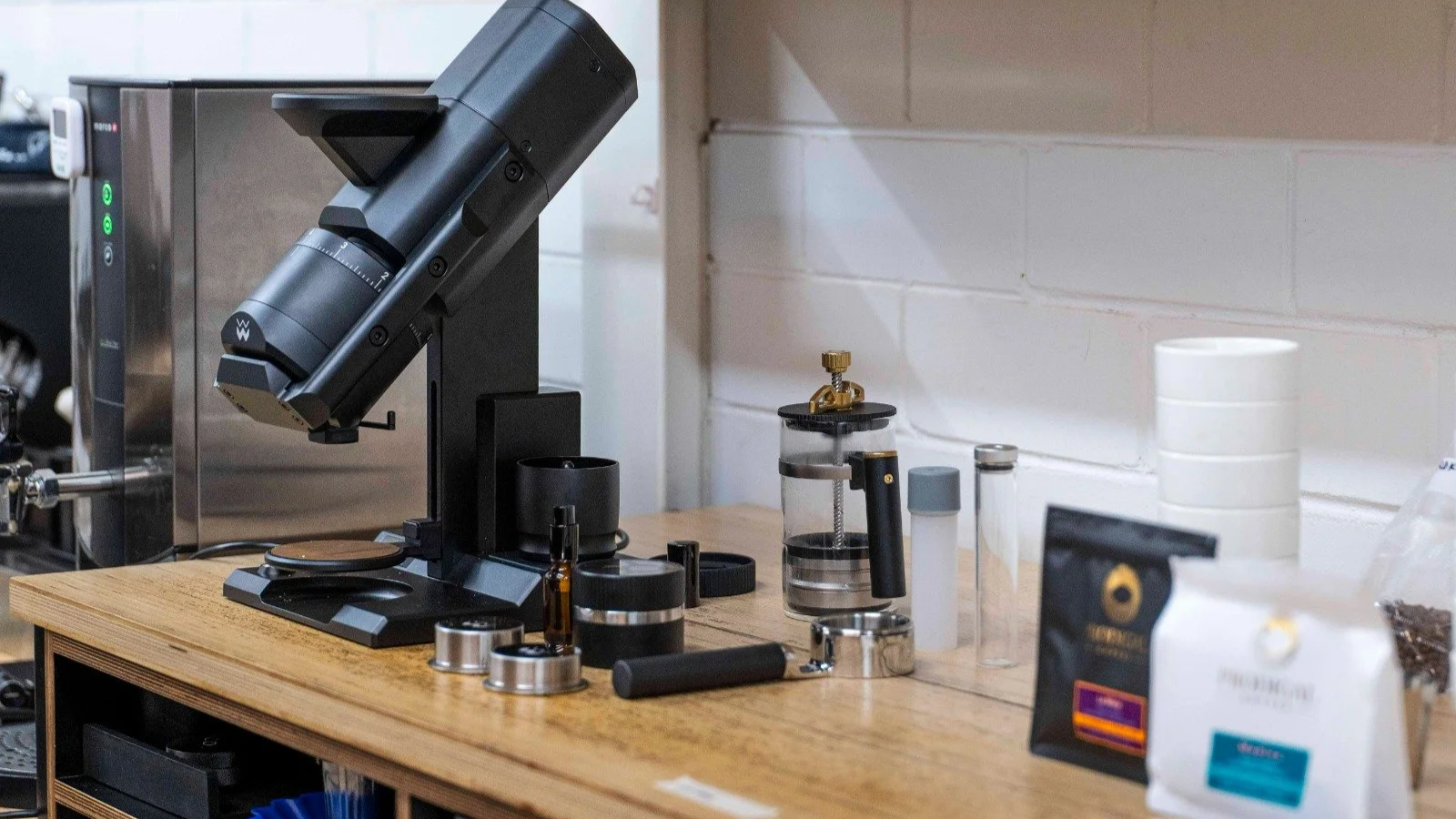
Weber EG-1 grinder and “The Bird” brewer
I often get asked versions of “what grind setting would I use for a v60 and the xyz grinder?”
There are a few problems with these questions:
I’ve usually not used that grinder (Not sure if people think I test different grinders daily. That’s Lance’s job haha)
Dose matters; the setting for a 15g V60 is much finer than that for a 30g V60.
Burr type, alignment, and sharpness may affect the optimal setting.
The amount of fines produced at a given grind setting varies for different coffees
Given that I almost certainly haven’t used the combination of coffee, roast level, grinder, brewer, and dose in question, the best I can do is recommend the person find the grind setting that produces the optimal total brew time for the dose and brewer in question. Even a reply such as “set the grinder to 650 um” is risky advice, given that the micron size of the PSD peak does not take into account the % of fines produced, and the fines have an outsized impact on flow rate through a coffee bed.
The Grinder
Twenty years ago, I had used the majority of pro-level grinders on the market. These days, there are too many grinders, and few people can name half of the pro-level grinders available, let along say they have used them. Lance has probably tested more grinders than anyone in the world, and even he probably hasn’t used half of the grinders on the market.
Many grinders now offer adjustable RPM, which complicates making settings recommendations, because when you increase RPM, 90% of the change in the PSD is the equivalent of turning the dial to a finer setting. (Eg “setting #5” at 400 RPM may be the equivalent of “setting #6” at 1500 RPM.)
The Dose
Deeper coffee beds offer more flow resistance, and require coarser grind settings than shallower beds do. For example, on an EK with settings 1—11, I might grind on #6 for a 15g V60, but #8 for a 22g V60. In a no-bypass brewer, increasing bed depth a certain amount may result in the need for a slightly greater coarsening of the grind than in a V60 or classic pourover.
Burr geometry, alignement, and sharpness
It’s no longer enough to say “what setting would you use on an EK43?” since there are so many different burr sets available for that and many other grinders. If a burr set is truly “low fines” one may need to grind a little finer than with a “core” or “HU” or “all purpose” burr set, AND one may prefer the flavor of the coffee with a slightly faster flow through the coffee bed with low-fines burrs.
If a burr set is poorly aligned, which is much more common than is discussed, the grounds will include more fines and more boulders. Generally, that will result in a faster flow rate at a given nominal setting on the grinder dial. This is easy to see when making espresso, so much so that I recommend using espresso flow rate as a guide to assessing burr alignment when installing new burrs on an EK. (Slower flow = better alignment.)
Fines production
The % of fines in the grounds has a massive effect on the flow rate of liquid through the coffee bed. Beyond burr geometry, fines production is influenced by roast level (darker >> more fines), coffee origin (Ethiopians in particular >> more fines), decaffeination (decaf >> a lot more fines), and the temperature of the beans (colder >> more fines). Many people believe coffee processing affects fines production, and sometimes it does a little, but its effect is drastically overstated. What those posts about naturals producing more fines than washed coffeees do often leave out is they weren’t comparing numerous samples roasted to the exact same ground color. (ie the naturals were darker)
Dialing In
The rule of thumb when dialing in is: begin dialing in at a coarser setting than you expect is required. If the grind setting is too fine, clogging and channeling will occur, causing coffee to be astringent, and often unpleasant. If the grind setting is a bit too coarse, the coffee may be a little weaker or more acidic than desired, but it is generally drinkable.
A second advantage of beginning too coarse is the shorter brew time will give you a good sense of how much finer you should grind on the next try. When the grind is too fine and the brew clogs or stalls, it may be much more difficult to estimate how much coarser you need to grind to find your optimal setting.